How to Stay True to Yourself When Your Creative Work Becomes a Business
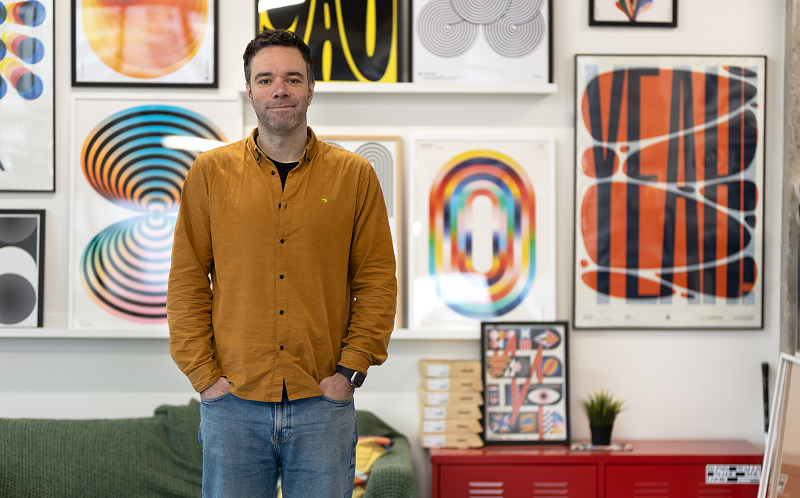
Geometry, bold colors, and an unmistakable visual style. PosterLad, whose real name is Vratislav Pecka, is one of those artists whose work you can recognize at first glance. He draws inspiration from the aesthetics of the 1990s and from childhood memories – a time when shapes were simple and colors were bold. Beige-and-gray minimalism is nowhere to be found in his work.
Vratislav’s journey didn’t begin with a carefully crafted brand strategy, but with a desire to do things his own way. How does a freelance graphic designer become an internationally recognized artist? In our interview, PosterLad opens up about creative freedom, balancing art and business, the pressure of social media algorithms, and why authenticity is essential in design.
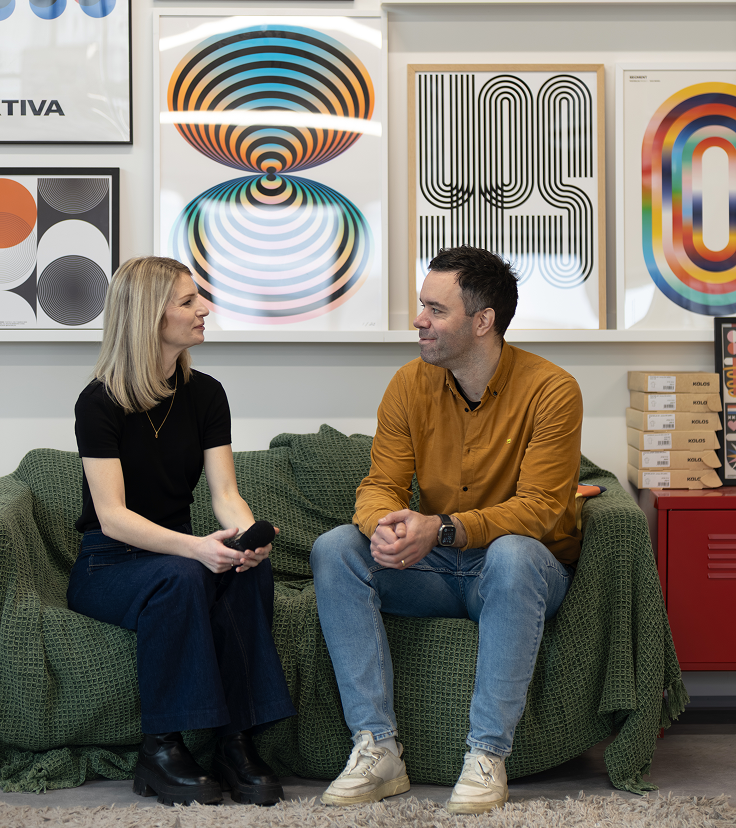
You have half a million Instagram followers, but it took years of hard work to get there. How did you first get into graphic design?
After high school, I moved to Písek, where I studied first at a higher vocational school and then at the Miroslav Ondříček Film Academy. But even during my studies, I realized it wasn’t quite what I wanted to do. I didn’t want to be just one of many people contributing to a final product. Back then, before social media existed, I needed a website where I could showcase my work, so I taught myself how to build one. That led me to spend more and more time working with graphic design software. Before leaving school, I designed a new logo for the institution, and that was when I finally realized graphic design was the path I wanted to pursue. I went on to spend more than ten years working for clients, first as a freelancer and later running my own studio. But over time, I started feeling the need to create something of my own rather than just working on commissioned projects.
When did your hobby turn into PosterLad?
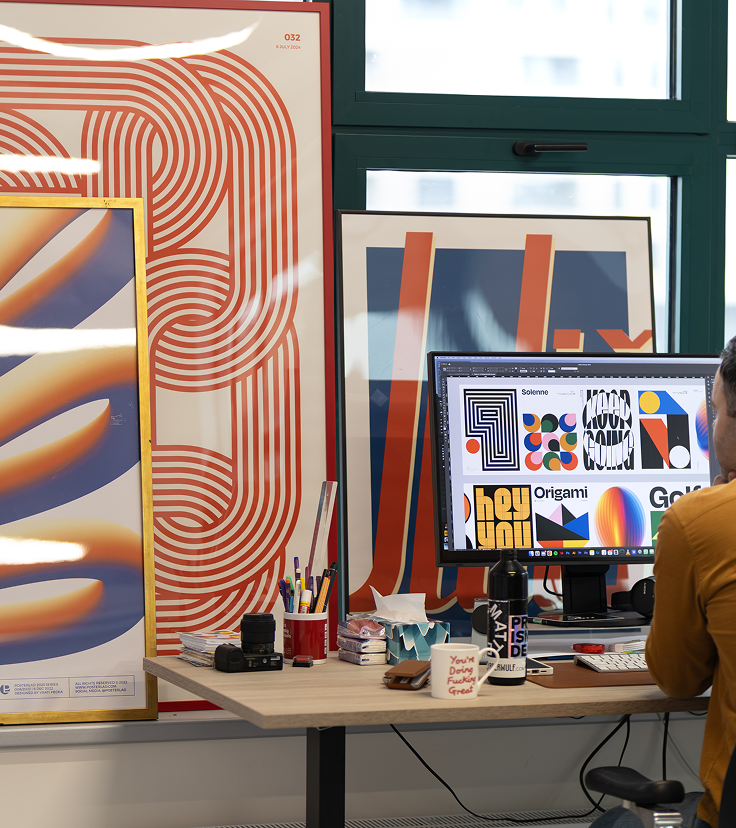
In 2016, I created an Instagram account, later expanding to other social media platforms, and started sharing my first posters. After about six months, I could already see that my work was improving. When I compared my earliest posters with the more recent ones, the difference was obvious. The compositions were cleaner, my use of color was more refined, and my overall visual language had become more consistent. Then someone messaged me asking if they could buy one of my posters. Gradually, I began to realize that if I invested enough time and energy into it, this could eventually become more than just a hobby. During the COVID-19 pandemic, I had quite a bit of free time as a freelancer, so I took some online courses in marketing and e-commerce and launched my own online store.
PosterLad emerged when social media was still in its early days. How do you see the way these platforms have evolved?
Back then, Instagram had a single square feed. No Stories, no carousels, no pressure from the algorithm. All you had to do was use the hashtag #posterdesign, and your account would naturally reach people, especially those in the creative community. Instagram was more of a gallery than a performance-driven platform. Today, things are completely different. What works with the algorithm today might not work tomorrow. It’s an endless and often exhausting process of constantly having to learn and adapt. At the same time, though, it’s never been easier to educate yourself, whether through online courses or tutorials. I also try to maintain a presence on other platforms, including X, Threads, and Substack. Each has its own unique characteristics, and I try to tailor my approach accordingly.
How did Instagram come about?
2010
Kevin Systrom and Mike Krieger found Instagram in San Francisco, USA
2012
Instagram gets a new owner: Facebook (now Meta) acquires the platform
2016
Instagram Stories: Major shift in user behavior
2017
Carousels and the growing influence of the algorithm
2020+
Videos and Reels: The shift to a video-first platform
Today, Instagram primarily serves as a performance-driven distribution channel, where the algorithm has a greater impact on reach than the content itself.

I got 10 likes, and I was thrilled.
You draw inspiration from the 1990s, Bauhaus, and childhood memories. How does an idea typically evolve into a finished piece?
Most designers start with a sketch and then develop it further. I might start with two circles, add a square, and see where it takes me. It’s a bit like playing a game. I often scrap the design altogether, but sometimes something good comes out of it. Occasionally, I finish a piece in ten minutes, while other times I keep coming back to it over several days. But I still spend most of my time working on the composition and colors.
I remember having four colored circles on my locker in kindergarten. Those images still keep coming back to me in my work.
What is the Bauhaus School of Art and Design?
The Bauhaus was founded in Germany in 1919 as an art school by architect Walter Gropius. Its goal was to bring together art, craftsmanship, and industrial design, creating a visual language rooted in functionality and simplicity. The core principles of Bauhaus included clean geometric shapes, the use of color, and an emphasis on purposeful design. The Bauhaus aesthetic had a profound influence on graphic design, architecture, typography, and product design, and its legacy remains visible in modern visual communication and contemporary branding.
Recently, you’ve also been experimenting with lenticular printing. How does this technique work?
I create short animations of my designs, usually about one second long, which gives me 24 frames. These are then combined into a single image for printing. Lenticular printing is a technology that allows an image to change depending on the viewing angle. You can never fully predict the result, and that’s exactly what I enjoy about it. You never know precisely what the finished piece will look like.
How do you stay true to your own visual style while also making your work commercially successful?
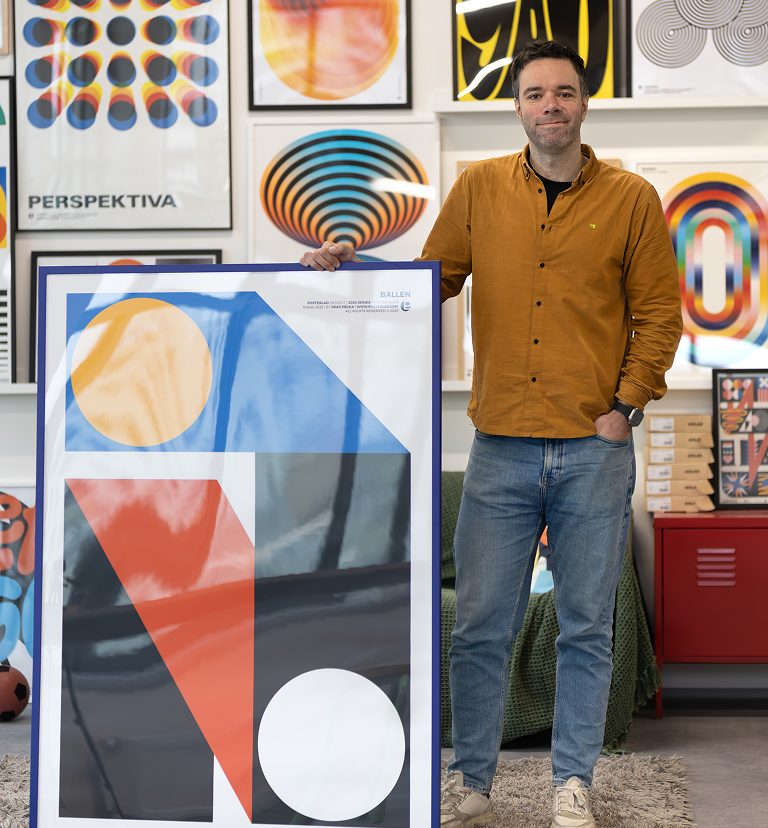
Whenever I start working on something new, I subconsciously decide whether to create something that will sell well or something I personally like. I try to strike a balance, but more often than not, I end up making what I actually want to make. Ironically, the designs that sell the best often turn out to be the ones I wasn’t particularly confident about at first. There are downsides, too. Sometimes people copy my work and pass it off as their own. Some even sell it without giving me any credit.
You’ve already had several exhibitions in the Czech Republic and abroad. Which one do you remember most fondly?
One of my favorite exhibitions was at 3sec.gallery in Breda, the Netherlands. It was a solo exhibition of my posters in a space completely unlike a traditional gallery. The exhibition took place in a long tunnel, where we installed several dozen of my works. People driving through could see them all in about three seconds – hence the name. I found this unconventional approach to exhibiting art incredibly powerful and original, and the response was fantastic.
What Is 3sec.gallery?
An unconventional gallery in Breda, the Netherlands, located in a tunnel at the entrance to the Chassé Parking garage. Its exhibitions are designed to be experienced in motion – whether on foot or while driving.
The gallery focuses primarily on poster art and visual design, regularly showcasing works by international artists. Its unique approach to space, rhythm, and fleeting moments of attention makes it a place where art naturally becomes part of everyday urban life.
And what about the art scene back home?
In the Czech Republic, I organized an exhibition called Urban Structures in Prague. Inspired by Czech architecture, it took place in a gallery space in the city center. The exhibition featured a series of posters exploring different types of urban structures and distinctive architectural elements found in Czech cities. It was amazing to see how people connected the designs with their own memories of places across the country. The opening event was completely sold out, and thanks to our collaboration with Prague Tourism, the exhibition also attracted plenty of international visitors.
How do you see the role of AI in creativity and art?
I take a pragmatic approach to AI. I use text-based AI as a tool, for example, to proofread texts or brainstorm ideas. I see greater risks for traditional graphic designers, but I don’t think artists will disappear or be replaced by AI. People will always want something real.
The art of doing things your own way
Over time, the PosterLad brand has expanded far beyond the world of posters. Through collaborations with brands such as YKRA, Kalas, and others, its distinctive visual language has naturally made its way into fashion and product design. The brand has also ventured into the music industry. PosterLad created a lyric video for the American band OK Go’s song Fantasy vs. Fantasy. Other projects followed, including a collaboration with the LIV Golf tour on a limited-edition collection of golf bags, ski goggles for Scott, and an artistic collaboration with Lynk & Co Czech Republic, for which PosterLad designed a full vehicle wrap.
PosterLad’s approach is surprisingly simple in some ways, but never careless. It’s colorful in spirit and playful in nature, much like the visual language he keeps returning to. It’s rooted in trusting his own decisions and being willing to accept the outcome, whatever it may be. No overcomplicating things, no unnecessary shortcuts. Just pure ’90s spirit.
Who is Vratislav Pecka /PosterLad
Vratislav Pecka is a Czech graphic artist and the creator of PosterLad, a project he launched in 2016 to produce original posters that blur the line between fine art and design. His work is characterized by geometric shapes, vibrant colors, and influences ranging from Bauhaus to the aesthetics of the 1990s.
He has exhibited in the Czech Republic and internationally, including in the Netherlands, France, the UK, the US, and China. Alongside traditional art prints, he also explores lenticular printing and digital art forms. Today, PosterLad is an independent artist brand with an international reach, built on a consistent visual identity and a distinctive personal style.